

Introduction
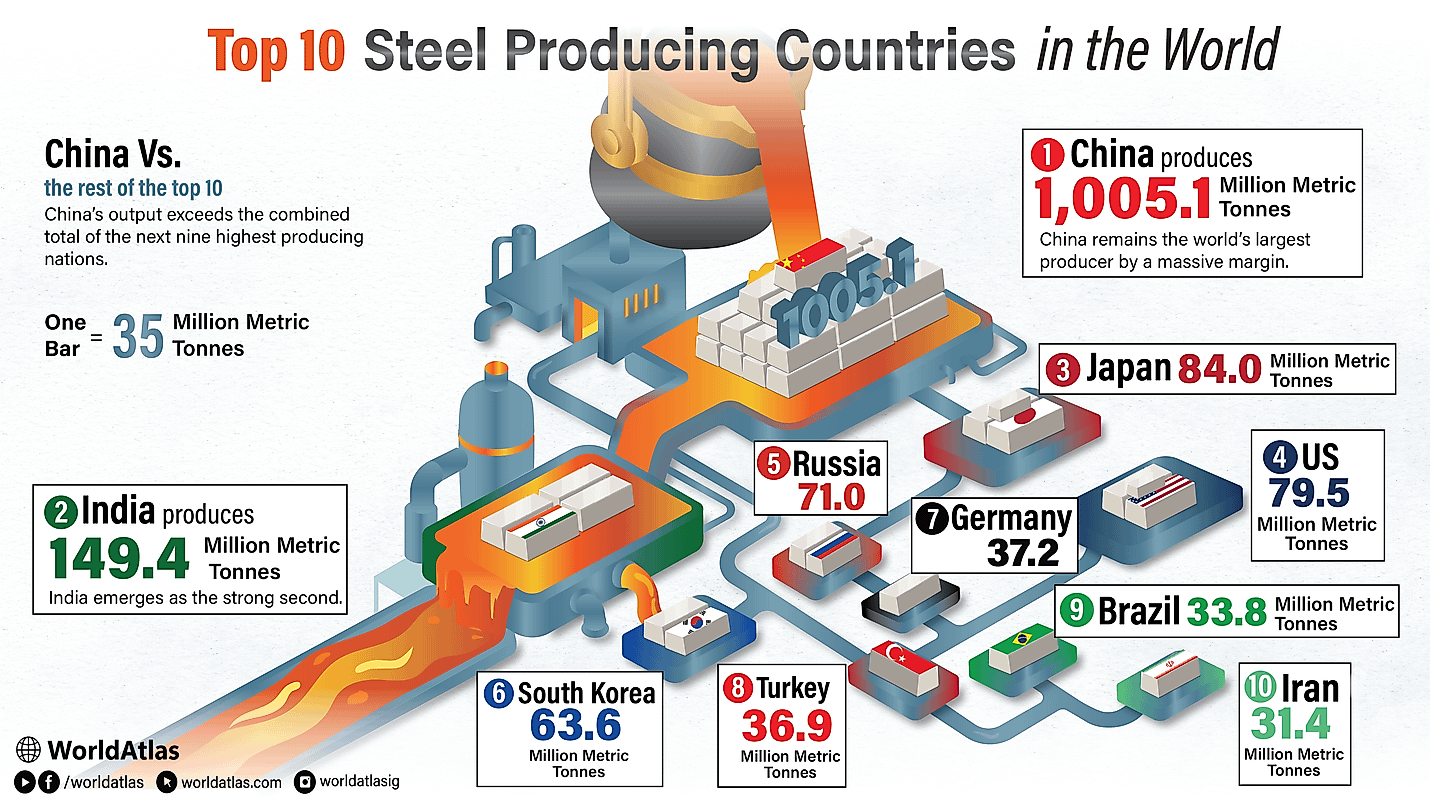
Steel remains one of the most vital materials driving modern civilization. From life-saving medical instruments to everyday kitchenware and massive infrastructure projects, its applications are endless. As global demand for steel continues to climb, production levels are reaching new heights, with a few nations leading the charge. In 2024, China once again dominated the global steel market, producing over one billion tonnes of crude steel—nearly half the world’s total output. Alongside China, a handful of other countries, including India, Japan, and the United States, form the elite group of top steel producers. Together, these ten nations account for more than 1.5 billion tonnes of steel annually, highlighting the material’s critical role in the global economy. Below, we take a closer look at each of these steel powerhouses, their production figures, and the unique characteristics of their steel industries.
- China — 1,005.1 Million Tonnes
China stands far ahead of any other nation in steel production, with an astounding 1,005.1 million tonnes of crude steel produced in 2024. This figure represents roughly half of the world’s total steel output and is nearly seven times that of India, the second-largest producer. Although production dipped slightly compared to 2023 due to softening domestic demand and government-imposed caps, China’s steel industry remains the world’s most influential.
The country’s steel journey began in earnest during the 1950s, when the Five-Year Plan prioritized industrial growth. Today, China is home to Baowu Steel Group, the world’s largest steel company, which alone produced over 130 million tonnes in 2024. Most of China’s steel is consumed domestically, with 85-90% used locally—primarily in construction, infrastructure, and manufacturing. The industry also provides employment for around three million people, making it a cornerstone of the national economy.
- India — 149.4 Million Tonnes
India solidified its position as the world’s second-largest steel producer in 2024, with an output of 149.4 million tonnes. The country’s steel landscape is a mix of global giants like Jindal Stainless, JSW Steel, and public-sector leader SAIL, alongside thousands of small and medium-sized enterprises that contribute nearly half of the nation’s total production. Government initiatives like “Make In India” have further fueled growth, with dozens of new plants under construction and ambitious targets to reach 300 million tonnes by 2030.
India’s steel sector is not just an industrial powerhouse—it is an economic lifeline, contributing about 2% to the nation’s GDP and supporting over 600,000 direct jobs. Abundant iron ore reserves give India a strategic advantage, reducing reliance on imports and ensuring long-term sustainability.
- Japan — 84 Million Tonnes
Japan produced 84 million tonnes of crude steel in 2024, securing its place as the world’s third-largest producer. Led by industry titans such as Nippon Steel, JFE Holdings, and Kobe Steel, Japan’s steel industry is renowned for its focus on high-grade and specialty products. These are essential for the automotive, shipbuilding, and electronics sectors, where precision and quality are non-negotiable.
While domestic consumption remains strong, Japan is also a major exporter, shipping 31.1 million tonnes to over 120 countries in 2024. Despite a gradual decline from its 2015 peak, the industry remains highly competitive, thanks to cutting-edge technology, a skilled workforce, and a commitment to innovation.
- United States — 79.5 Million Tonnes
The United States ranks fourth globally, producing 79.5 million tonnes of steel in 2024. The U.S. steel industry is uniquely structured, combining traditional integrated mills with more than 100 mini-mills that recycle scrap metal into new steel. This approach makes the U.S. one of the world’s most recycling-intensive steel industries, processing over 60 million tonnes of scrap annually.
Despite its impressive output, the sector employs only about 85,000 people, reflecting high levels of automation and efficiency. The U.S. also remains a key player in global steel trade, with Canada and Mexico as its top export destinations. However, imports still account for roughly 25% of domestic consumption, highlighting strong internal demand.
- Russia — 71 Million Tonnes
Russia produced 71 million tonnes of steel in 2024, maintaining its position as the world’s fifth-largest producer. The industry is deeply integrated with mining and contributes nearly 5% to the country’s GDP, while employing over 600,000 people. Major players like NLMK, Severstal, and Evraz dominate the market, benefiting from Russia’s vast reserves of iron ore and coking coal.
However, recent geopolitical tensions and sanctions have disrupted exports, particularly to European markets. In response, Russian producers have increasingly turned to Asia, the Middle East, and CIS countries. Despite these challenges, domestic demand remains strong, particularly in construction, energy infrastructure, and rail projects.
- South Korea — 63.6 Million Tonnes
South Korea continues to be a global steel powerhouse, producing 63.6 million tonnes in 2024. The industry is led by POSCO, one of the world’s most advanced and efficient steelmakers, known for its high-value products like automotive-grade steel, shipbuilding plates, and electrical steel. South Korea’s steel sector accounts for 1.5-2.2% of national GDP and over 4% of exports.
The government is actively supporting the industry’s transition to low-carbon production, with significant investments in hydrogen-based steelmaking. A 400 billion won export guarantee program and long-term sustainability goals ensure that South Korea remains at the forefront of global steel innovation.
- Germany — 37.2 Million Tonnes
Germany, Europe’s largest steel producer, manufactured 37.2 million tonnes in 2024, ranking seventh worldwide. The industry directly employs around 80,000 people and supports millions more indirectly through manufacturing, logistics, and engineering. German steel is primarily used in the automotive and construction sectors, with exports totaling nearly US$30 billion in 2024.
The industry is undergoing a major transformation, with companies like thyssenkrupp and Salzgitter investing heavily in hydrogen-based production to reduce emissions. However, high energy costs have limited output, keeping production below 40 million tonnes for the third consecutive year.
- Turkey — 36.9 Million Tonnes
Turkey produced 36.9 million tonnes of steel in 2024, ranking eighth globally. The country’s steel industry is built on a robust electric arc furnace infrastructure, which relies heavily on scrap metal imports. Over half of Turkey’s steel is consumed domestically, supporting construction and machinery sectors, while exports reached 15.5 million tonnes, shipped to more than 190 countries.
Industry leaders are optimistic about future growth, with expectations that production could exceed 40 million tonnes by 2026. Turkey’s strategic location and access to major shipping routes make it a key player in global steel trade.
- Brazil — 33.8 Million Tonnes
Brazil is the largest steel producer in Latin America, with an output of 33.8 million tonnes in 2024. The country has an installed capacity of around 50 million tonnes, meaning there is significant room for growth. Steel production is concentrated in regions like Volta Redonda, which has been a steel hub since the 1940s.
Brazil benefits from abundant iron ore reserves and integrated port infrastructure. Major producers like Gerdau and ArcelorMittal supply steel to automotive, construction, and infrastructure projects. However, the industry faces challenges from low-priced imports, which reached a 15-year high in 2024.
- Iran — 31.4 Million Tonnes
Iran rounds out the top ten with 31.4 million tonnes of steel produced in 2024. The country’s steel industry is one of the most resilient in the world, overcoming challenges such as frequent power outages through innovative solutions like non-state power generation and alternative energy sources. Iran’s focus on hot-rolled coil production and its vast domestic iron ore reserves provide a strong foundation for growth.
A significant milestone in 2024 was the widespread adoption of a domestically developed third-generation Direct Reduced Iron catalyst, now used in 30 steel plants. This innovation has improved efficiency, reduced energy consumption, and saved over $400 million in foreign exchange. Iran also exports this technology to regional markets, showcasing its growing expertise in steel production.
Conclusion
The top ten steel-producing countries demonstrate the immense scale and diversity of the global steel industry. From China’s overwhelming dominance to Iran’s remarkable resilience, each nation brings unique strengths and faces distinct challenges. Together, they produce over 1.5 billion tonnes of steel annually, supporting economic growth, infrastructure development, and millions of jobs worldwide. As demand for steel continues to rise, these countries will remain at the heart of global industrial progress.

